ASURA's ARU system on national toll road network - eight months, six daytime and six nighttime sessions, every vehicle passage cross-checked by human auditors.
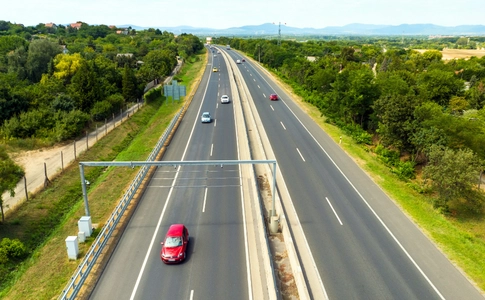
Collecting precise data at motorway speed
This national motorway network handles millions of vehicle passages every year. Free-flow tolling is a zero-margin environment: a vehicle crosses a gantry in fractions of a second. Miss the detection and the revenue event is gone. Detect the vehicle but fail to read the plate and enforcement is impossible.
Legacy systems addressed these problems with radar triggers and fixed rules, but struggled with the full diversity of real traffic - variable speeds, mixed vehicle classes, night conditions, rain, and headlight glare. The operator needed more than a capable system. They needed an independently audited proof of performance, event by event, across the widest range of real-world conditions.
Specifically, the validation had to answer three questions: Does the system detect every vehicle? Does it read every plate? And - critically - where do the rare failures occur? At the sensor, or at the reading engine?
ARU - Asura Recognition Unit
ASURA's ARU replaces radar-triggered hardware with AI-vision triggering. The camera video stream is processed continuously; the detection model fires on any vehicle entering the frame. No additional sensor, no calibration drift. Once triggered, a dedicated licence plate reading engine operates independently - giving operators a two-stage, auditable pipeline where each layer is separately measurable.
- AI object-detection triggering No radar dependency. The model learns from the video stream itself, adapting to every vehicle type in real traffic without external triggers.
- Multi-condition robustness Consistent performance across day and night, rain and glare, low contrast and high-speed pass-through - without manual recalibration.
- Two-stage auditable pipeline Detection and LP reading are independently measured. Operators see exactly what each layer contributes - not just a blended headline number.
- Gantry-native deployment Compatible with existing camera infrastructure. No road-level modifications required.
Ground truth. Event by event.
Each audit session was validated by a human review team who cross-checked the ARU event log against raw video footage at every gantry position - independently, passage by passage. The team's manual log served as the ground truth reference for every metric in this study.
Results were compared across three metrics that together give a complete picture of system performance and pinpoint the origin of any gap:
ARU events ÷ GT passagesDid the sensor layer see the vehicle? Measures detection independently of what happens in the reading engine afterward.
Plates read ÷ GT passagesThe operator's primary operational metric. Every unread plate here - whether missed by detection or by the OCR engine - is a missed enforcement event.
Correct reads ÷ ARU detectedThe OCR/LPR engine's isolated score. Of every vehicle the detection layer captured, how many plates were correctly read? Separates engine capability from sensor reach.
Each metric isolates a different layer of the pipeline
The gap between Read Rate 2. and Recognition Accuracy 3. reveals where failures originate. A narrow gap means both layers perform near-identically - failures at detection and at the OCR engine are both small. In either case, operators have an engineering-grade signal that drives the right remediation action, not just a single blended figure.
The programme ran 6 daytime and 6 nighttime sessions across distinct gantry positions, covering more than 6,500 independently validated vehicle passages and up to 10 simultaneous camera positions per session.
September 2025: the largest validated session
With 1,130 independently verified vehicle passages across 9 gantry cameras, the September 2025 daytime session is the most statistically robust single session in the programme - and the results leave no room for ambiguity.
Every one of the 9 gantry cameras scored above 98% - bars are scaled across a 98–100% window so the small differences are visible.
| Gantry camera | Detection | Read | Status |
|---|---|---|---|
| Camera 01 | 99%+ | ||
| Camera 02 | Flawless | ||
| Camera 03 | 99%+ | ||
| Camera 04 | 99%+ | ||
| Camera 05 | 99%+ | ||
| Camera 06 | Flawless | ||
| Camera 07 | Flawless | ||
| Camera 08 | Flawless | ||
| Camera 09 | Flawless |
"Across 1,130 validated passages, just 6 vehicles went undetected and just 5 plates went unread by the engine - 11 total missed events across 9 gantries in a live motorway session."
November 2025: consistent accuracy after dark
Free-flow tolling demands uncompromising performance at every hour. The November 2025 nighttime audit validated the ARU system against 359 independently verified passages across 10 gantry cameras - after dark, in the full range of motorway lighting conditions.
September daytime against November nighttime on the same three metrics. Bars scaled across 90–100%.
"Of the 352 vehicles detected in the November nighttime session, 350 plates were correctly read - a 99.43% Recognition Accuracy, matching daytime results."
Eight months. The same answer every time.
A single exceptional session proves capability. Eight months of consistent results prove production readiness. The six daytime sessions - May through December 2025 - covered distinct gantry positions with independent ground-truth validation at each.
Across all six daytime sessions, detection averaged 99.3% and Recognition Accuracy averaged 99.4%. The spread between best and worst session is narrow - under one percentage point on either metric. This is not a system that performs well in isolation; it is a system that delivers consistently, at scale, across the operational year.
The data is the argument.
Validation programmes exist precisely because field conditions don't resemble lab conditions. The national motorway network - with its traffic mix, seasonal weather, and around-the-clock operational demand - is an exacting test environment. The ASURA ARU system was asked to perform in it for eight months, under independent audit, with every passage verified by human reviewers.
Across six daytime and six nighttime sessions, and more than 6,500 ground-truth-verified vehicle passages, the results are consistent: Vehicle Detection Rate above 99% by day, Recognition Accuracy of 99%+ on detected vehicles regardless of lighting, and a transparent three-metric framework that gives operators an engineering-grade view of every layer of the system.
The case for ARU isn't built on a single exceptional session. It's built on a programme that returned the same answer, session after session, across eight months of live motorway traffic.